
The Hidden Side of Aid
On resilience, loss, and the unseen work of disaster relief

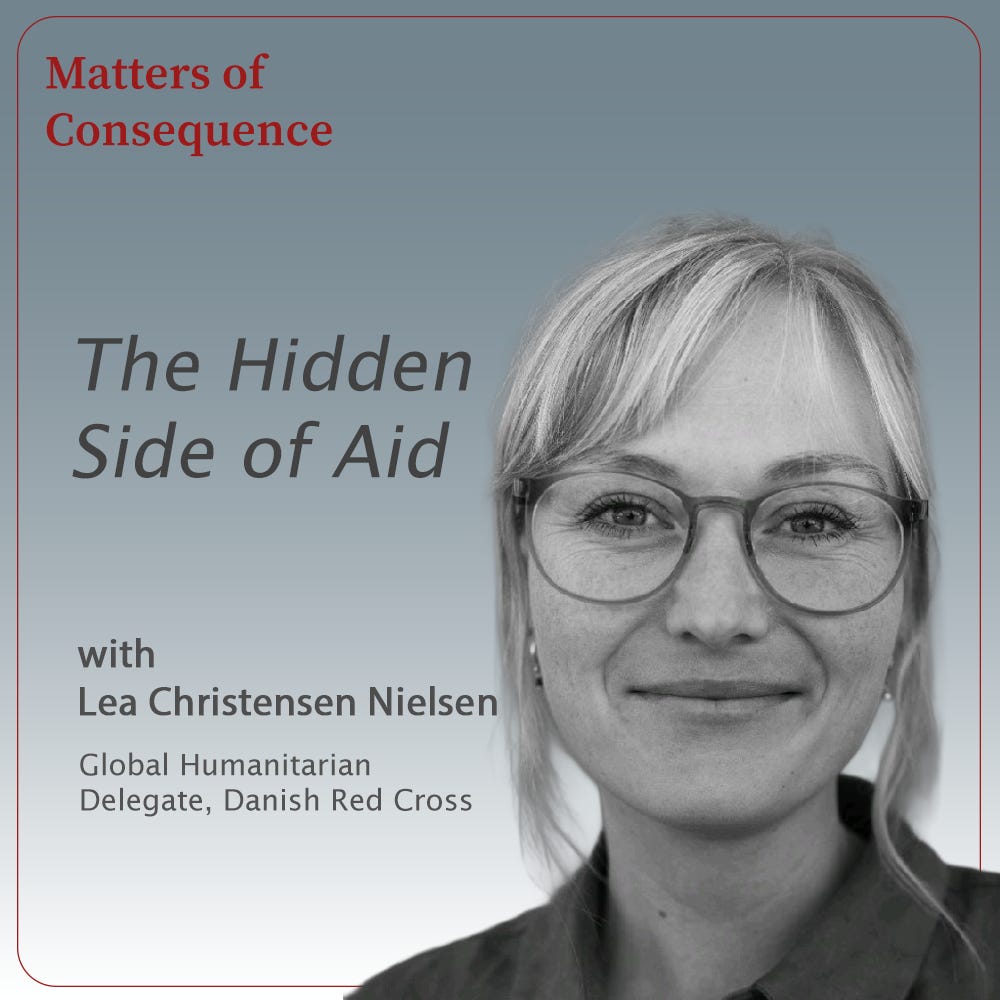
Very early on, when planning the 3rd Season of the Matters of Consequence podcast, I wanted to invite a person with lived experience in disaster relief and humanitarian aid. Looking at the news and the political discussion of these topics, I felt it important to explore how it feels to take responsibility in crisis situations. What does it take to step forward in times, when everything around you is chaos. So, I reached out to the International Red Cross and Red Crescent (IFRC).
In my conversation with Lea Christensen Nielsen, a Global Humanitarian Delegate for the Danish Red Cross and an Operations Coordinator for the IFRC we talked about disaster relief and humanitarian aid in the Middle East and North Africa (MENA) region. Lea highlighted the importance of local organizations and volunteers to provide a continuous presence in a region that is marked by protracted crises.
What became clear is that the work of disaster relief is not just about responding to crises, it’s about being there before, during, and long after the headlines fade. Lea described how local volunteers, often from the very communities they serve, are the backbone of this effort. They are the first to respond and the last to leave, carrying the weight of decisions that can mean life or death for those in need. And yet, their work often goes unnoticed by the wider world, overshadowed by the next breaking news cycle.
We also discussed the emotional toll of this work. Lea shared how the loss of colleagues, 19 staff and volunteers this year alone, weighs heavily on those who remain. And yet, despite the risks and the heartbreak, they continue to show up. Because, as Lea put it, if they don’t, no one else will. There’s a quiet resilience in that commitment, a determination to keep going even when the world seems to have moved on.
But what struck me most was the tension between the urgency of immediate relief and the need for long-term resilience. In MENA, crises don’t come one at a time. They compound. Conflict, displacement, natural disasters, all overlapping and eroding the capacity of communities to bounce back. And yet, the funding and attention often focus on the short term, leaving the long-term needs unmet. How do we bridge that gap? How do we ensure that the work of building resilience doesn’t get lost in the noise?
That’s the question Lea’s work leaves us with. And perhaps it’s the question we all need to sit with.
You can listen to our full conversation on your favourite podcasting platform and on Podlink: https://pod.link/1814542720/episode/NmE0MjZlNzI3MTY2OGUzNzA2MDUyNzk2