
The Risk of Hope
On Art, Climate Psychology, and the Courage to Feel

When I came across the Climate Psychology Alliance one day, I got interested in the concept and focus the organization has. The Alliance is a nonprofit organization that explores the psychological aspects of climate change and ecological crises. Based on my earlier conversation with Clover Hogan, I went deeper and found the profile of Kate Adams. Kate is a performance maker, lecturer at the University of Salford and member of the board and co-chair for the Climate Psychology Alliance. In her research she explores how artistic practices can strengthen relationships with the natural world and engage emotions in our climate and ecological crises. As I found the combination very interesting to further explore, I invited her on to the Matters of Consequence podcast.
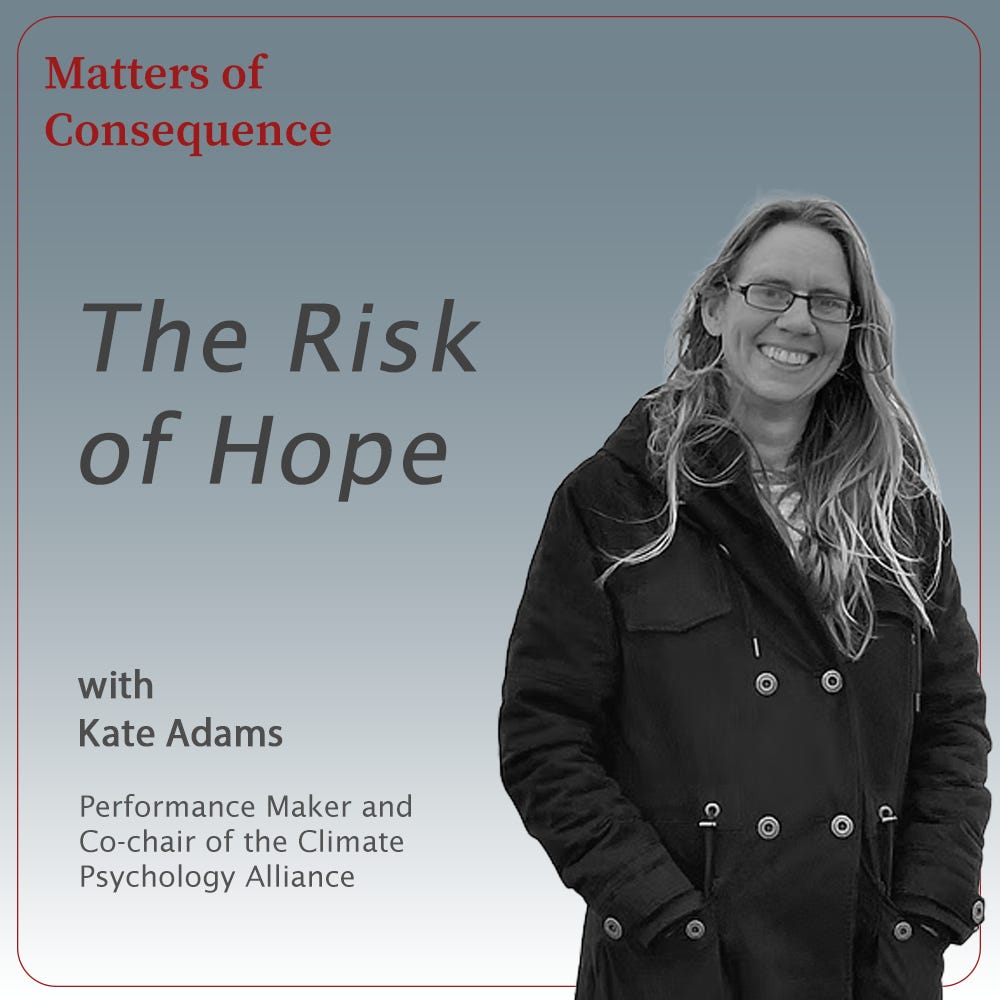
In my conversation with Kate, she described how grief can manifest physically, how she feels it behind her right shoulder blade. It made me think about the weight of the work we do in sustainability, strategy, and systemic change. The weight of knowing, of carrying the tension between what is and what could be.
We talked about her work as a performance maker, lecturer, and co-chair of the Climate Psychology Alliance. How her performances, like Water is Attracted to Water, explore the emotional weight of the climate crisis. How she creates spaces where people can confront grief, anxiety, and even hope without judgment. She shared how shame and guilt often paralyze action, and how her work focuses on breaking down those barriers.
Kate also reflected on the physical toll of emotions. How they can get stuck in the body if we don’t acknowledge them. She spoke about the importance of practices like Qigong to ground herself, and how we in the West often lack the tools to process these feelings. Her journey is one of vulnerability, of finding ways to engage with the climate crisis not just intellectually, but emotionally.
But what stayed with me most was her idea of the risk of hope. How do we allow ourselves to hope for change when the path forward is unclear? How do we keep showing up, even when the outcomes are uncertain? That’s the question Kate’s work leaves us with. And perhaps it’s the question we all need to sit with.
You can listen to our full conversation here.